



Showing posts with label Calypso. Show all posts

Wednesday, July 21, 2010

Chapter 29: GONE A-MAYING


It ought not to have taken long, the overland journey from Falmouth on the southern coast of Antigua across the interior to St. John’s. But Jack kept their pace slow. It wasn’t only concern for the horses, who were accustomed to pulling their loads in the tropical heat; Jack wanted to savor the spectacle of their procession in the landscape. The Bruces’ caravan had a fresh coat of red and white paint, and the pantomime wagon had been festooned with honey-scented white and yellow jasmine vines and pink oleander just this morning. It was their triumphant return to the English islands after a long interlude, and they wanted to make a show.

Which indeed they did. Jack and Cully walked at the horses’ heads, keeping their pace stately. Jack wore a colorful patchwork waistcoat pieced together from scraps, while Cully played a wobbly but cheerful tune on a cane pipe. Alphonse sat on the box, driving the pair, with a sprig of red flamboyant stuck in the band of his straw hat. Cybele and Calypso strolled behind with Tory, dressed in Columbine’s motley skirt and juggling painted pins. Marcus and Edward racketed around in the road between all the others, and the Bruces in their brilliant caravan brought up the rear. There was not much traffic on the road this morning: one or two astonished Negroes driving ox carts, occasional white gentlemen on horseback riding off on plantation business, washerwomen with their bundles of laundry, hucksters sniffing the back roads for items to trade. But Jack tipped his hat to one and all. He would never have thought he’d be so happy to be back among the English.

They had spent a happy and profitable spring in the French islands. Cybele had purchased a license and set up a stall in the Pointe-a-Pitre marketplace on Guadeloupe. After exploring the countryside, they began to perform their Harlequinade at the Sunday slave markets. The colony was made up of two large islands, and an aggregate of smaller ones, inhabited by sugar planters or fisher-folk, so there was no shortage of market towns to play at of a Sunday.

Tory had thrown herself into the work with her whole heart when told of their true purpose, inspiring Jack to devise ever more exuberant and hilarious business. Alphonse, of course, roundly proclaimed they must never endanger themselves on his account again. But they paid him very little mind, and when it became clear they would play the Harlequinade with or without him, he grumbled that he must resume his Punch role if only to maintain the quality of their performances.

They had all reunited with the Bruces yesterday in Falmouth, here on Antigua. It would be the rainy season, soon, yet they might get another month of playing out of the Sunday market in St. John’s before they retired to the protection of English Harbour for the hurricane season, to plan for the Bath Hotel.

But Jack could not worry about the future on such a fine, dry morning. It surprised him how much this trek through the interior lowland of Antigua reminded him of England. This arid island was not so lush and hilly, but the rolling flatlands planted in green and gold cane might have been any farmland in rural England. The few creeks and riverbeds they saw were dry at this time of year, but they passed a freshwater pond where mill cattle were driven to drink by straw-hatted boys. Of course, the boys were black, and the tall palm trees and clusters of spiky aloe, with their willowy shoots erupting in sunbursts of flame red, would have looked strangely exotic in Devon or Gloucestershire. But Jack had once seen English May Day revelers in Jamaica dancing around a towering aloe as if it were a Maypole.

May Day had come and gone while they were in the French islands, and with it another year of his life. It must be midsummer by now. But as he looked back to see the boys gamboling and giggling in the road, and Tory sauntering along, smiling up slightly at her work, he realized that every day felt like May Day to him, now that he knew how much Tory loved him. A fragment of an old Maying song from the West Country began to play in his head, an exuberant air he could no more suppress than he could have stopped the beating of his heart.

"Robin Hood and Little John
Are both gone to the Fair-O.

And we will go to the merry greenwood
To see what they do there-O!"

"Bravo!" came Billy Bruce’s hearty cry from the box of his caravan on the road behind the wagon. Jack laughed, and finished up what he could remember.

"For we were up as soon as any day-O.
And for to fetch the summer home,

The summer and the May-O!"

Jack had spent his childhood traveling through green country villages in company every bit as motley as this. For so long, he had forbidden himself to remember his boyhood at the English fairs; it hurt too much, with the reminder of all he had lost. But his boyhood memories were flooding back now, from every hidden corner of his heart, and he welcomed them, cherished them. Then his eye fell on Tory again, and he knew he was no longer a boy.


I heard Jack singing today, after a fashion, Tory wrote in her logbook, that evening. I would not have missed that for all the seas in all world!

She found herself smiling at the memory, and the memory of these last few busy and prosperous months ashore in the French islands. I don’t believe any man can truly understand how important it is for a woman to have something useful to do. Calypso has her needle. Cybele has her herbs and the raising of her children. And her cards, for which she is duly famed in Pointe-a-Pitre, where she is called la diseuse de bonne aventure, teller of fortune. To think that Alphonse tried to deny me the one contribution I have learned to make on dry land, my Columbine, because of the risk. There is risk in every moment of life, but we can't stop living because of it.

Tory lifted her pen and thought back to the day she and Jack had returned to the others. Her homecoming. Alphonse was so relieved, he almost smiled. Then he insisted they give up the Harlequinade.

"Has anyone actually run away because of our playing?" she countered.

"One or two of those Alphonse spoke to as slaves have become his informants in the free communities," Jack offered.

"Hellfire, we’ve actually done some good?" she crowed. "And you expect us to give it up? Besides, all your people depend upon you, Alphonse."

"What people?" he frowned.

"Those you employ in the hills. To aid runaways." To his astonished look, she added, "Do you not know a fellow called Quashie?"

"I know dozens. It is an African name for a son born on the first day of the week. Planters often use it as a name of derision, Quashie or Cuffee, or a salutation to a Negro they do not know."

Tory told him of the naked young Quashie, glistening with goose grease, who had helped her get off the mountain. She told him of the safe houses she had visited in her journey, some overgrown shacks but others neatly tended.

"But—I employ no one," said Alphonse.

"Perhaps he was on his own account," Tory suggested. "It must mean something to them, maintaining those places. Keeping the dream alive."

"You’re sure this fellow called himself Quashie?" Alphonse asked.

Tory nodded.

"In African tales, Quashie is sometimes the name of a hero who helps the people trick their masters. But he is...a myth."

"This fellow was real flesh and blood," Tory laughed. "But here’s another odd thing. I could swear once or twice, he called himself Jonkanoo. Like the parades."

"It is often spoken as a name, two words," Alphonse mused. "John Canoe. A personage."

"The Lord of Misrule," Jack smiled. "Like you, Alphonse. You show them a looking-glass world where slaves outwit their masters and invite them to act out the dream. Like the Lord of Misrule."

Since then there has been no more talk of giving up the Harlequinade, Tory wrote. And now that the performer in him has been unleashed again, Jack can scarcely be contained. I often find him in grog shops of a market afternoon, spinning tales to whatever sea dogs he can find who understand even a smattering of English or Spanish, embroidering some fanciful yarn about something he calls the Devil’s Ring. It may be that he's plotting a new scenario and wishes to try its effects before he puts it on the stage. It sounds a great load of rubbish to me, but perhaps it's one of those stories that comes off better in the playing.


A mild morning had given way to the dull, brassy heat of noon as Alphonse trudged up the hill from town toward their campsite. But he scarcely minded the heat when the morning’s business was so successfully concluded.

He had met with Mr. Jepson’s agent at his branch office in St. John’s to dispose of Jack’s business. Jack insisted on setting aside a generous share of his profits from the French islands for that fellow Hannibal in Basseterre, the informant who told Jepson where Tory had gone. It was enough for a manumission, and Alphonse was promised that Jepson would see to the matter without delay.

Alphonse was feeling almost chipper for another reason. At no time in their interview had Jepson’s agent spoken a word about the situation on Nevis. Their remove to the French islands had kept Alphonse far out of the way of Nevis and her troubles. He could not be accused of failing to honor his pledge if he were never contacted. Now that they were back in the English islands at Crop-over, with traffic between the islands at its busiest, however, he might be held accountable for his pledge at any time. But the situation might have changed on Nevis, he tried to convince himself. Perhaps the business would come to nothing, after all.

But Jack’s business had come to something and Alphonse was eager to tell him so. He found the clearing deserted, their wagon and the Bruces’ caravan standing quiet with the horses tethered nearby, and so decided to try the wagon. He jumped up onto the step, swung open the door and popped in over the threshold. His reception was a sudden, fearful gasp from Calypso, perched on the stool in the corner. She dropped her sewing in her lap as her dark eyes rounded in terror, then snatched it up again in two small, trembling hands.

"Mist’ Alphonse, you 'bout scare me to death!" she exclaimed. There was a deep, wine-dark flush on her cheek. "Jack say bolt the door, but I forgot."

"What does he mean, leaving you all alone like this?" Alphonse's voice came out too sharp, to cover his embarrassment. A sensible man would have knocked first. "Where are the others?"

"Cybele and Tory picking herbs, but I stay behind to finish this mending. Then Cully and Marcus come say they lose Edward playing chase in the wood, so Jack go off wit’ them to find him."

"Perhaps I ought to go help them."

But Calypso merely shrugged. "Edward get lost all the time. He like the attention."

The unfamiliar twinge of a smile tugged at Alphonse’s mouth.

"It is very dangerous to stray too far from the wagons. I wish you..." He had been about to say "you children," but that word did not seem to fit the small, neat young woman sitting before him, her fingers working with such industry. "I wish the boys would believe me," he amended.

"Cully getting too big to trifle wit’, Marcus be too fast and Edward too little for anyone to notice."

"Marcus was not fast enough in Charlestown."

"We can no be hiding all the time," Calypso reasoned.

"I suppose not," Alphonse agreed, gazing at her. How much more poised she seemed, these last months, than the timorous girl they had first met, wanting only to hide behind Cybeles skirts. When did the change happen? How could he have been so foolish not to notice? Alphonse did not know the precise nature of whatever had made Calypso so afraid, but he had lived long enough as a slave to imagine several plausible scenarios, each more horrible than the last and none of them at all out of the ordinary in the normal course of plantation life. Then he realized her dark eyes were dancing at him.

"Mist’ Alphonse, you boring a hole clean t’rough me."

Mortified, Alphonse stammered an apology and fled to the water jug on the sideboard. Glad of the chance to collect himself, he poured water into the gourd cup, which he managed with no little dexterity as he climbed the two-step ladder to perch on the edge of the bunk. From up here, Alphonse was almost at eye-level with any adult who came in the door, and slightly higher than Calypso, whose short black curls bounced above her shoulders as she bent her head over her sewing.

"I wish you would not call me 'Mister'," he spoke up, after a sip of water. "It makes me feel a hundred years old."

"Cybele say we must speak to you wit’ respect because you all be so kind to us."

"Oh? I notice no one ever says Mister Jack."

"It no suit him."

Did he himself seem that exalted, Alphonse wondered, that aloof from his companions? "It will suit me if you simply call me Alphonse."

The girl nodded and went back to her work.

"Mending for those boys must keep you awfully busy," he observed, to be saying something.

"But I don't mind. I expect to 'prentice out to a seamstress in a shop, one day. Or else I hire out for a place wit' some fine lady of the town."

"As a servant?"

"One day. I must live free two years in one place to get my certificate. Then I hire out."

Alphonse’s mouth compressed into a taut line. Even if they were able to settle down tomorrow in one place, this girl would be nearly twenty years old before she could be declared legally free. Free to enter into another kind of bondage, in many ways as dreary and humiliating as the one she had escaped.

"You no tink much of my plan," Calypso observed, watching him now with a more guarded expression.

"In my experience, there is little difference between servants and slaves."

"Servants earn a wage," snapped Calypso. "It be no shame to work."

Alphonse stared at her, amazed not because her sudden anger was so unexpected but because it was so familiar. It was exactly the tone he took himself whenever some well-meaning idiot was determined to offer him pity or sympathy. He knew what it was to be laughed at, jeered at, pursued, even assaulted; there were sure ways to deal with those things. But he would not be patronized like a child. In those moments, he could not bear his own fury and that was what he saw in Calypso’s eyes now.

"We must all work for our living, of course. I had no right to speak to you like that." There was nothing humble in his apology. He merely stated the fact and Calypso nodded, satisfied.

He set the cup behind him on the window sill and sat watching her work. It occurred to him he never saw her idle.

"If you had the choice," he began again, "to do or be anything you wanted, what would you choose?"

Her eyes were smiling when she met his gaze. She did not need to rebuke him with a reminder that she had very few choices and she was still child enough to be intrigued by the fancy of it. "Why, I tink I like to have a child of my own."

Alphonse kept his face composed, only wincing inside. How easily she would reach that goal, he thought, no doubt with the help of the husband of the fine lady she would serve. "And a home of your own?" he prompted.

"Or a shop!" she grinned. "So the fine ladies come to me!"

"And a fine, strapping husband, I suppose..."

Calypso’s sparkling eyes clouded immediately. "Yes...I s'pose... only..." she faltered, then gave him a plaintive look. "It no be easy for me to...talk to men, you see."

"You are talking to me."

It was out before he could stop himself and Alphonse wanted to bite off his tongue. Now he had invited her to compare him to other men. But Calypso did not laugh or dismiss him. If anything, her expression cleared a bit.

"Yes that’s so," was all she said.

Alphonse wished he had some sewing in his lap to distract him from that calm, steady gaze. But there was nothing for it but to bear her scrutiny until she spoke again in a more playful voice.

"And what about you...Alphonse? If you could do anyting at all in the world, what it be?"

"I’d see an end to slavery."

This time she did laugh. "Oh, that be a very fine ting, but it nevah happen. I mean for you’self. What you want for you’self?"

Alphonse had never been asked what he wanted personally out of life, nor had he ever asked himself. What did he want? What any normal man wanted, he supposed, although it would be fatuous of him to say so. He was hardly a normal man. Work he had aplenty. And companionship? That was new to him, but not unpleasant. Before Jack and Victoria, he'd had ony acquaintances. Love? But he had bolted the door of his mind to that subject long ago.

"You want more than a shop and a child, I tink."

No, less, he thought. If she only knew how much less he would settle for, if only it were possible.

"I have...much to do," he said, at last. "My...wife...I am afraid, would have to be a saint."

"Then you have a long wait," said Calypso, returning to her work.


(Top: View to St. Johns Harbour, Antigua, by J. Johnson, 1827. As seen on www.brunias.com)

Wednesday, February 3, 2010

Chapter 5: FORTUNE'S FOOLS


"Sweet grass give your lover a fine disposition," chanted the herb woman in a soft, throaty sing-song. "Hot pepper light a fire in the loins. Dried poppy ease the blood."

A young Negro woman in plantation linens handed her a lush green vegetable out of her basket in exchange for a small packet.

Tory was drawn to the shade and the spicy fragrance in the stall here at market day in Old Road Town. The herb woman sat under a canvas awning in a dress striped in indigo and white. All around her were baskets of herbs tied in stalks or powdered in papers, and a few small pots of live plants. But Tory was eyeing the cards laid out on the ground before her, beautifully engraved images of fanciful figures and mythic creatures inscribed with French names.

"You care to know your fortune, young ma’m’selle?"

Tory glanced up at the herb woman’s handsome honey-colored face, into lively hazel eyes under a brilliant blue and gold headscarf. There was an underlay of musical patois beneath her careful English. The slave woman had hurried away. A young mulatta girl sat behind the herb woman in the shade, bent over some sewing, with a very small, dark boy asleep on a pallet beside her.

"Thank you, ah, no," Tory responded. "Have you a balm for bruised skin?"

The herb woman broke off a small, spiny tip from a succulent plant, squeezed its sticky juice into a gourd dish and mixed in a paper of dried herbs. "And no fortune today?" she asked, as she wrapped up the paste in a plantain leaf.

Tory remembered the last time the cards had been read for her, as a green romantic girl in Boston. They had led her into the indifferent embrace of Matty Forrester.

"I find I’m less likely to make a fool of myself in the present if I don’t know what Fortune plans for my future," she replied.

"Fortune make fools of us all, if we read the cards or no," the herb woman chuckled, shifting forward to hand Tory her packet.

"Thank you, ah…"

"I am Cybele, mother of mysteries."

"Do you solve mysteries or create new ones?" Tory smiled, nodding at the cards.

"The mysteries of Fortune are not problems to solve. They are not explained here," and Cybele pointed to her kerchief-tied head. "They must be understood here." She laid her hand lightly on her bosom. "The cards solve nothing. They may show you the pattern of your life, if you care to look."

"If there is a pattern," Tory snickered.

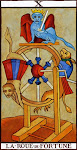
"Always a pattern, always a design," Cybele chanted. "The Great Mother has her reasons. Ah," and she turned one of her cards face-up. "La Roue, the Wheel of Fortune. She is not a game to play and she will not be deceived. Treat her gifts with respect, or they may vanish—poof!—with the next turn of the wheel."

Tory caught her breath. "What gifts?" she echoed.

"I do not know, the cards speak to you." Cybele turned up another card. "Le Pendu, the Hanged Man. A sudden change, a sacrifice."

Cybele eyed Tory again, but Tory could not respond. She had already given up the sea. What else would Fortune demand of her?

"L'Amoreaux, the Lovers," Cybele went on, turning up a third card. "There is a choice in your future. A choice of lovers, perhaps?"

And the spell was broken. This was not the voice of Fortune, Tory realized, only a matronly vendor in a market stall. Sweet grass and love potions. Credulous females were such easy prey.

"Now you no believe me. I say the wrong thing," Cybele smiled. "But a choice very important to you, one day. Do not make it lightly."

"I'm sorry, the cards never work for me," Tory smiled back, handing her a coin for the balm. "And for the cards?"

"Wisdom from the Great Mother ask no payment."

Two boys came whooping and laughing into the herb woman’s stall, one small and black, in a red headscarf, and his bigger companion, and Tory turned away, preoccupied with her own thoughts. She hurried back to her own pitch across the market square. She and Jack and Alphonse had split up to have a look around, but the herb woman’s idle talk reminded her of the dangerous game they were playing with Fortune.

Nearing their pitch, she spied Alphonse around the corner of another vendor's stall, speaking quietly to a black man in slave linens. Then a barrage of high, boisterous laughter made her look around. A little crowd of children was dancing around a tall black youth operating a Punch-and-Judy show on a wooden plank hung from his neck. His little glove puppets savaged each other with sticks while howling away in a yeasty mix of island English and African slang, and the laughter that greeted each new assault came not only from the delighted children but from those few vendors and hucksters who were still about.

"There go the rest of the day’s profits," said Jack, strolling up behind her, his eye on the puppeteer. "Enterprising fellow, to do it all himself."

"He tells a story," Alphonse mused, coming out to join them. His visitor had evaporated. "As we do not."

As the puppeteer marched past them amid the swarm of children, Jack turned to smile at Tory.

"I’ve brought you something, Rusty." He held up a wide-brimmed lady’s straw bonnet. Dark green satin ribbons trailed down the back with a great folly of pale green netting and peach-colored paper rosebuds pinned to one side. Tory could only stare in astonishment. "I thought it might do for the sun and it’s less servile than that confounded kerchief," Jack added, a bit nervously now. "If you don’t care for the color..."

"I love the color!" Tory cried, whisking it out of Jack’s hands. She pulled off her headscarf and settled the hat over her pinned-up hair. Relieved, Jack tweaked it gently into a more rakish angle.

"Less like a slave?" he asked Alphonse.

"More like a mistress. But that is better, yes."

The market was closing down; most of the vendors and custom had already fled to the grog shops by the time they collected their things. That was why the commotion at the far end of the square was so noticeable as they began to trudge past.

"If you can’t produce your certificate, I’m obliged to hold you in custody," boomed a constable. Tory recognized the herb woman’s canvas awning and stopped, nearly upsetting Jack behind her.

"They mustn’t take her away," Tory whispered. The formidable mulatta stood before the constable while her children watched from under the awning. "She has all those children to look after."

"He’s just trying to move her along," Jack assured her.

"Sir, I have mislaid it," Cybele was telling the constable, her rich voice very precise. "But I am many years a free woman. No person in this village say they ever know me as a slave."

"It’s not my business to prove you’re a slave, but yours to prove you’re not," the constable fenced back. "If you cannot produce your freedom papers or the name of a master to speak up for you, you become the property of the township. You know the law."

"By law, I am a free woman."

"Law," snorted Alphonse at Jack’s elbow.

"I spoke to her earlier," said Tory. "Her name is Cybele. She does no harm."

"What will happen to her?" Jack asked Alphonse.

"If she has no papers, she can be taken into custody and sold as a slave. Her children, too."

"She has no other recourse?"

"Not unless she conjures up a white master to claim her."

"Can we cause a disturbance so she can get away?" Tory urged.

"She won’t get far with those children."

The petrified girl and the three boys gathered behind Cybele’s skirts as the constable brandished a pair of wrist-manacles.

"If you can’t come peaceably..." he growled.

Cybele stared at him as if to freeze him to the spot. Alphonse looked murderous. Tory was frantic.

"Oh, hellfire and damnation," Jack muttered, and marched into the fray. "Here you are at last, Cybele!" he thundered, in his most theatrical tones. "I’ve lost half the day looking for you. I told you to meet us at the other side of the market and now look at the fracas you’ve caused. She’s my wench, sir, and the brats too," he added, irritably, to the constable. "I bought ‘em at auction in Basseterre and a fat lot of trouble they’ve been to me ever since."

The constable and Cybele both stared at Jack.

"But she said she was a free woman," the constable protested, the shackles itching in his hands.

"That’s what they always say," Jack harrumphed. "You know what they’re like. But they’re mine, all right, I’ve papers to prove it." He reached toward his shirt, then paused. "Although I’ve half a mind to turn 'em all over to you, constable, as a lesson for vexing me."

The littlest boy chose this moment to burst forth with a flood of noisy tears. The constable blanched.

"A night or two in gaol, that would suit you," Jack growled to Cybele. " 'T'would certainly suit me."

"They’re your look-out, not mine," the constable retorted. "Only get them out of the public road, and keep an eye on 'em if you don’t want 'em taken up for runaways." And he stalked away.

"Come, let’s be off before he changes his mind," Jack hissed as Tory and Alphonse came up. The boys set to rolling up the canvas awning in the bamboo poles. Cybele swept her gaze over Tory, then Jack, and gathered the rest of her things. Nothing more was said as they started off together, only to halt when the small mulatta girl refused to budge, staring after Jack with the same terror with which she had beheld the constable. Cybele murmured something in French, and the child came reluctantly forward, never taking her eyes off Jack. Cybele steered her gently along as they all left the marketplace.

"This is far enough, no one will pursue you in this heat," said Jack, once they had gained a secluded spot near the road out of town, occupied by only a few scrabbling chickens. "You’ll be safe now."

"Safe?" echoed Cybele. "To do what?"

"Why, to go about your business." Jack stopped when he saw her face. "B’God, woman, you don’t imagine I meant to keep you?"

"I know only that my children and I dare not appear in this town now without you," Cybele replied. "It will cause suspicion."

"Well, then...I free you," Jack countered, in exasperation. "Can I do that?" he asked Alphonse.

"If you can prove you are the legal owner."

"And how do I do that?"

"Without papers, the waiting period is one month..."

"A month!"

"...and then you must pay the manumission fees," Alphonse concluded.

Jack’s face fell further. "Can we afford it?"

Alphonse shrugged.

"Well, we can’t abandon them here," Tory insisted.

"You must not pay my manumission," Cybele spoke up. "I am free already."

"But you have no papers."

"I have papers. Only we arrive here in some confusion." Her gaze swept across the jumble of baskets, poles, slings and bundles she and the children carried. "We always arrive in some confusion."

"Her papers will turn up," Tory coaxed. "It won’t be for long."

Cybele caught her eye; in spite of everything, the herb woman looked slightly amused.

"You see how Fortune weave the pattern of our lives together." She turned to Jack. "Sir, we are indebted to you, but it be my custom to pay my own way."

"I’m delighted to hear it,” Jack replied drily. "We planned to leave tomorrow for Sandy Point Town. I hope that will suit you."

"I go where Fortune direct me," Cybele nodded. "As we all must."


It was not much of a wagon, a sturdy old sugar wain to which someone had attached a high, thatched canopy. Nor was it much of a cart horse, a mottled chestnut with a greying muzzle and a lethargic attitude whose only distinction was that—arguably—he was not a mule. But Jack and Alphonse had purchased this fine equipage at the Sunday market, and were as proud of them as if they were winged Pegasus and the chariot of the sun. They could not wait to bring them to the lodging house to show them off.

Sandy Point Town was the most populous town on St. Kitts after Basseterre. But there were no lodgings to be had together for a buckra man, two ladies of color, a Negro freeman and a brood of black and brown children. Jack was obliged to take a room above a tavern, which Alphonse shared by posing as his servant. Tory had to make her berth with Madame Cybele Le Blanc and her children in a lodging house run by a mulatta widow who tolerated them for the sake of Cybele, who read her fortune each day and brewed potions for her rheumatics. It was to this residence that Jack and Alphonse brought their new prize.

"But...what are we to do with them?" Tory wondered, from her perch on the landlady’s front steps.

"Ride?" Jack suggested.

"Yes, but..." Tory waved a hand at the vehicle, long and wide and deep in the bed, but open on all four sides between the poles holding up the thatch. Wind and rain would take their toll on anyone or anything inside.

"We shall make improvements," Alphonse spoke up. "We shall raise the frame and timber it over to keep out the weather."

Jack leaned into the back of the wagon and lifted up the end of a roughly planed wooden board. Peering in, Tory could see a pile of mismatched boards inside.

"Scrap timber," Jack beamed. "Alphonse knows a fellow who scavenges it."

"Still...it must have cost something."

"A trifling amount," said Alphonse. "We shall soon make it up."

"The carriage is sound," Jack chimed in. "We’ll put in shelves for storage and a door we can lock. And a sleeping bunk to save on lodgings."

By now, the children had seen them and came tumbling down the steps. In the lead was small, black, wiry Marcus, the middle boy, with his old red bandanna tied over his high forehead. Behind him came Cully, a stocky, amiable mulatto of twelve or thirteen—Cybele was imprecise about their ages. Little Edward was about five with chocolate brown skin and surprising misty-blue eyes, "a true child of the Indies," Cybele called him. He was tugging on his sister’s hand, but he broke away for the shelter of Tory’s skirt when he saw the size of the horse from the perspective of the bottom step. Which left the girl, Calypso, hanging back on the step above Tory. With her light complexion under a jumble of dark corkscrew curls, she scarcely looked old enough for her first bleeding. Yet Tory read a gravity in her dark, wary eyes that did not suggest youth. It didn't seem possible that these mismatched children could have had the same father—which put Tory a little in awe of Cybele.

To Tory’s surprise, Calypso suddenly darted down the steps past her. The girl, who was so terrified of all two-legged males except the boys and Alphonse, strode up to the cart horse, gave his wet muzzle a gentle rub and asked what his name was.

"We did not think to ask," Alphonse admitted, taking the reins as Calypso continued to pet the animal’s nose.

"Poor old nameless ting," murmured the girl.

"Why don’t you give him a name?" Alphonse suggested.

Calypso looked seriously at Alphonse; they were almost eye to eye because she was so small. "But I might pick the wrong one."

"Mohawk children are often given several names," said Tory. "As a child grows up, and his parents get to know him, they might change his name to something that suits him better."

Calypso stroked the horse’s muzzle, smiling a little. "Then we name you later, poor old ting, when we know you bettah."

"We’re taking him back to the inn yard and we’ll need some help cleaning out the wagon," Jack announced. He reached for the reins, and Calypso shrank away like the shadow of a cloud sliding across the grass. Jack pretended not to notice, turning instead to the boys and calling, "Who knows how to use a currycomb?"

"Me!" cried Cully. "Me work one time in the coach house."

"Me learn too!" Marcus piped up.

"Don’t worry," Jack promised, "there’ll be plenty of work for everybody."


It had been a dozen years since Jack had been charged with the care of a horse, but it was amazing how quickly it all came back to him. That had been that last summer at St. Bart’s Fair, when he was fifteen years old. The last time he saw his parents.

He turned away from the memory toward the tack room wall, with its traces and bridles and cartwhips and spare bits, and parts of harnesses hung up on pegs. The tavern kept its own stable of post horses for hire to customers who wished to drive to Basseterre, so there was no shortage of supplies. The tavern-keeper was even trading them feed for the old chestnut in return for Jack, Alphonse and Tory performing outside his door after the Sunday market, to lure custom inside.

Alphonse had arranged it, of course. Jack half-smiled as he replaced a currycomb Marcus had left in the stall again. Alphonse could arrange anything. It was an education to watch him prowl the marketplace in the morning to see who had the plumpest chickens, the sweetest preserves or the sturdiest tinware to sell, and which domestic was in need of a pig for Massa’s noonday meal or silk for Missy’s new ball gown. He matched buyers to vendors, skimming off a percentage in coin or trade for his trouble, or bartering his own information. The horse and wagon had come at a reduced cost because Alphonse was able to put the trader in the way of some fine imported lace for another of his clients. The timber was nearly free, so eager was the old scavenger to do Alphonse a good turn.

Alphonse was a skilled hand with hammer and nails, as well. Jack was no mean carpenter himself, after years of outfitting decrepit barns for playhouses, and he could see that Alphonse knew what he was about; every plantation had its own carpentry shop where an apt fellow might pick up the trade. And Jack thought again how ironic it was that Alphonse had come to him seeking protection. There was nothing that Alphonse could not manage on his own. It was Jack who was beginning to feel superfluous.

He gazed out the little window above the worktable into the yard. The wagon stood in the afternoon shadows, its new walls and roof in place, the doorway framed in. They were building the sleeping bunk, now, then they would put in the shelves, hang the door and whitewash the interior. Not much left to do.

He turned away from the window and headed back into the main part of the stable. The double door to the yard was glazed with late-afternoon sunshine. Jack glanced at the old chestnut in the last stall, munching contentedly on some cane trash Alphonse had procured from somewhere. The haze slanting in from outside was so bright, Jack almost didn’t see the movement, but he heard two soft plops in the straw-strewn dirt and an exasperated outrush of breath.

Gliding over without a sound, he peeked around into the little alley between the last stall and the stable wall. Marcus stood in the shadows with his back to the blinding light, each outstretched hand holding an old, filthy, half-chewed yam he must have filched out of the horses’ feed trough. The boy braced himself in a crouch, then flung both yams high up into the air over his head. His face jerked upwards to follow their flight and his small hands clawed at the air for an instant, then he ducked and wrapped his arms around his head as the yams came crashing down again. Undaunted, he trotted forward to scoop them up, crouched and braced, and threw them upwards again, managing this time to bat one away from him in its fall while the other clipped him hard on the shoulder.

Jack leaned against the stall, arms folded across his chest, watching in utter fascination as the intrepid boy gathered up the yams yet again. His next attempt would likely crack open his skull.

"There are easier ways to knock yourself on the head, you know," Jack observed.

Marcus literally jumped, then spun around, thrusting the yams behind his back as if he had been caught with something precious.

"Why..." the boy stammered, "...me no mean no harm, Massa..."

"Jack," he corrected the boy. "Try one at a time," he added.

"What?"

"One yam at a time," Jack repeated, nodding toward Marcus’ hidden hands. He had not made any move toward the boy and was still leaning on the stall. "Throw one up and catch it."

"Any pickney catchy one yam," Marcus scoffed.

"Aye, well let’s see you do it."

Marcus sighed, but he stooped down to place one yam on the ground. He straightened and threw the other one into the air, darted backwards two steps and caught it in both hands. Pleased with himself, he did it again, this time overthrowing slightly to one side and having to veer sideways to make his catch. His black limbs were very thin, his movements quick, but gawky. Jack had been taller at that age, but no less awkward, all arms and legs. It was all in the training, and Jack had had the best.

"Don’t throw quite so hard," he suggested. "You’re not trying to bring down the moon."

The boy giggled, then remembered himself. He threw the yam more gently and caught it in his two hands. Jack nodded.

"Now try to catch it in one hand."

Marcus frowned in concentration. He tossed the yam upwards again, too high; it came down faster than he expected and he dropped it. He cast a sheepish glance over his shoulder at Jack.

"Never mind. Without mistakes, we’d never learn anything." Jack straightened, hands resting on his hips. "Just give it a little toss, this time. Like playing catch with Edward."

Marcus tossed the yam up a little way and caught it easily. He did this again and again, tossing it a bit higher each time.

"That’s good," nodded Jack.

"But me no be juggling," grumbled the boy.

"Best learn to catch one ball before you can catch four."

"Four? When me do that?"

"Soon enough, if you keep at it." He stepped a little closer to the boy. "Now try catching it in your other hand."

Marcus tossed the yam from hand to hand the first time. But he tried too hard the next time, overthrowing again, and Jack’s long arm shot out over the boy’s head to retrieve the wayward yam.

"Whoa, there! Remember what I said about the moon."

"Me only trow to the stars that time," Marcus declared.

"Well, aim for something a little closer to earth," Jack laughed. "This hand, here. That’s right. Good."

The bright haze was fading out of the doorway as the sun dropped behind the tavern roof. Jack motioned Marcus out of the shadows and into the middle of the stable, where there was more light and room. But when Marcus noticed the lengthening shadows, his face fell.

"It’s late," the boy muttered, with a reluctant glance at his yam, as if he were taking leave of his oldest friend. "Cybele, her be mad wit' me if me come back in the dark."

"I’ll take you back," Jack offered. When the boy still looked woeful, he added, "We can continue this tomorrow."

"For true?" The boy’s eyes rounded.

Jack nodded. "As soon as we get the bunk in. Oh, and leave the fodder to the horses, next time. Alphonse has some pins that will suit your hands better."

Marcus looked so giddy, Jack was afraid he’d burst apart.

"Hurry, now, or Cybele will give us both a tongue-lashing." Jack nodded toward the door and Marcus bolted past him out into the yard, whooping like a lunatic, his feet never touching the ground.


(Top: Fruit and Vegetable Vendor, Rio de Janeiro, Brazil, 1850s
Image Reference kidder7, as shown on www.slaveryimages.org, sponsored by the Virginia Foundation for the Humanities and the University of Virginia Library.)