


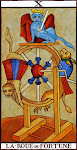

Showing posts with label Wheel of Fortune. Show all posts

Wednesday, June 30, 2010

Chapter 26: FORTUNE'S WHEEL


"I might have known with Mistress Lightfoot aboard, ye’d not be far behind," chuckled Ed Hart, as he handed Jack a jug of his best rum. "It gladdens me to know when my people swear an oath to each other, they see it through."

Jack sucked down a liberal portion of the rum, which made the friendly acquaintance of the brandy he’d had, earlier, steadying his nerves somewhat. Hart had invited him and Tory into his stern cabin to have a word in private.

"'Twas Nada recognized her in that Basseterre hellhole," the captain went on, nodding to his mate who crouched in the open doorway, where he could keep one eye on the companion ladder out in the passage. "I’d have thought all females were one to Nada, but it only shows how well ye may think ye know someone and still be surprised by 'em." Hart grinned fondly across at Nada. "He felt it reflected poorly on the dignity of the Providence for one of her crew to be sold into slavery."

Nada grunted off this evidence of his concern, and glared up the hatchway.

"I never even saw him in the place," Tory continued the tale, eagerly. "I was blinded by the lights around me, and he must have hung back in the shadows. Afterwards, I was so intent on getting away with Van Brugge and onto his ship, my guard was completely down. I never saw what was coming."

"Fought like a hellcat, she did," Hart chuckled. "Clouted poor Nada in the belly and damn near unmanned him before he had a chance to reason with her. He had to knock her on the head to get her aboard quietly."

Nada muttered something belligerent in Spanish about the female sex.

"Then, you were not forced to go with the Dutchman, this Van Brugge?" Jack asked Tory.

"He had a ship," she explained. "I had to get out of Basseterre."

"She was in a rare temper when she woke up," the captain continued. "Mad as a wet hen."

"Until I saw where I was, and with who," Tory smiled. "It was like a miracle."

"It’s Blesséd Providence," Hart agreed, taking another swig of rum.

"But how do you even happen to be in the Leewards?" Jack asked the captain. "We thought you were off to the Republic of Colombia."

"Oh aye, so we were. But Bolivar had alrady waged his last campaign at some Godforsaken outpost in Peru, on the far side of the continent, before we ever joined the fray. We sailed up the coast to Mexico for a time, to join the Mexican fleet blockading the Spanish garrison at San Juan de Ulua. But that’s not what any man would call action, certainly no fit duty for the Providence. It’s police work, and none of the men had any heart for it. We later heard that Bolivar’s ships had taken some rich prizes out of Havana, Spanish supply ships bound for San Juan de Ulua, and some of the men wanted to slip off home to Cuba and collect our share of the spoils. But the hell of it is, Cuba has become a way station for Spanish troops and warships trying to regain a toehold in Mexico, not only Havana but Santiago de Cuba. We can’t go home to Cabo Cruz with half the Spanish fleet stationed in our back yard."

He gave a bitter shake of his head and passed the jug to Tory.

"By the time we caught up with the Colombian fleet, it was stranded off Cartegena without enough seasoned hands to work their ships nor so much as a reale left in the Colombian treasury to pay 'em. So ended a damned unprofitable year, and an unlucky one. The fleet, as she pleases to call herself, is still off Cartegena for all I know, but we peeled off to cruise the coast to Caracas on our own account. But we didn’t like to disturb the commercial shipping bringing supplies to Bolivar’s republic—that’s what politics does to ye, warps your perspective."

"But what happened to the Providence?" Jack asked.

"Ah, what didn’t happen to her? As if the general wear and tear on that thankless cruise to Mexico and back wasn’t enough, she was pummeled in a gale in those rocky isletas off of Caracas."

"Pummeled?"

"Dismasted, for one thing. Her sternpost rattled, missing stays. Oh, we jury-rigged her, got her fit for the sea again, but she’s not what she was. But then our fortune changed." Hart’s black eyes lit up with cunning. "Fast as she is, we took this sweet prize out of Curacao; a smuggler all loaded up for market into the bargain. Ye must never, ever underestimate the value of surprise, especially when your enemy is a complacent fool."

"Maldito holandes," muttered Nada.

"Aye, another Dutchman, he was," agreed Hart. "Funny, ye rarely see ‘em in the pirate trade hereabouts, but every other merchant or smuggler you meet is one of ‘em. This fellow was a damned poor specimen of the breed, no sense of adventure, and a poor sailor. Had commercial interests all though the Indies, but none of his crew liked him much. When I asked who wanted to come aboard the Providence, damn if every man jack of ‘em didn’t volunteer! The lay of it was, we needed a faster ship until we could get the Providence in trim again, and this sloop needed a new captain. So we put the Dutchman and his steward into a boat, and entered into this venture with his crew. Half of ‘em went into the Providence with our men to sail into a safe anchorage while the rest of us complete this smuggling cruise up the Antilles. We’ve taken a few prizes along the way; amazing how much more attractive the trading ships of Europe become when they’re carrying supplies to their own fat colonies. We’ve increased our profit into the bargain, and everyone seems satisfied with the arrangement."

Jack took another turn at the jug and wiped his mouth, surprised to feel a short stubble of beard against his fingertips. "But where is the Providence now?"

"Saba. A little Dutch outpost above the Leewards. She’s not a sugar island, so no one pays any mind to what goes on there. Her people are smallholders, mostly, and Dutch merchants. And the occasional contrabandista or picaron in need of a friendly port."

"And you’re sure you can trust ‘em with the Providence? These fellows from the sloop?"

"I left Cuervo in command," Hart shrugged. "He'll keep 'em in good order. Salvador Gris and Rudy and Diego and a few others are on board to see to her handling; with a bit of babying, she ought to do fine. I’ve kept Mr. Bustamante and his best gunners here on the sloop; she’s only got four six-pounders, but that’s all ye need with such a fleet sailer, if ye know what you’re about. The rest of this crew are Dutchmen, and a few Brits, late of the French wars. As it happens, the second mate is a Hanoverian name of Dykstra. One of Bolivar’s German mercenaries. Shipped out of Caracas a few times under my command, and we struck up an acquaintance."

Jack grinned. "Is there anybody in the Indies you didn’t ship out of Caracas with, sometime or other?"

"Not many," the captain laughed. "All the flotsam and jetsam of Europe has floated down to the Indies these last twenty years, and I've sailed with most of 'em. This Dykstra’s a good lad. Reads books, if ye can imagine, navigates like a fish, and solid as a gold Spanish ingot. Took to the smuggling trade after Bolivar carried his revolution inland. Fellow of his mettle deserves his own command. I’m giving him the sloop after we split the profits, and I get the Providence back in trim. But they all know if anything goes awry, I’m keeping her." He sent a satisfied grin round the cabin that encompassed the entire ship. "Trim little strumpet, isn’t she? Fleet as the wind. Christened her Fortune when we took her, Rudy ran up the ensign himself."

"A gold compass rose on a blue ground," Jack nodded. "That’s how I knew her."

"Some of the lads call it a ship’s wheel under the Pole star," said Hart. "Myself, I see a gold doubloon marked with its cross."

Jack nodded, again; every doubloon was stamped with a cross for cutting it up into quarter bits.

"The coin of Fortune under the stars," mused the captain.

"Or Fortune’s wheel," Tory smiled at Jack.

"But I confess, I’ll not be sorry to leave the smuggling trade," Hart went on. "Ledgers, bookwork, timetables; it’s a job for an accountant. Dykstra takes to it like a cat in cream, the man’s got a ledger-book for a brain! But once we get the Providence back to rights...Hellfire, it’s like old times already having ye both back aboard! However did ye find us, Jack?"

"I came after Tory. I’ve been trailing you for weeks," he told her. "Ever since Marcus got back to Charlestown to tell us—"

"Did he?" Tory cried. "All by himself? Oh, thank all the gods, I’ve been so worried! Was he all right?"

"Shaken and scared, but he’s a plucky little fellow." Jack could not smother a grin of pride.

"He would sooner die than disappoint you," Tory nodded. "I should have known nothing would stop him."

"Alphonse and I—" Jack began again.

"Alphonse came with you?"

"He wouldn’t let me go to Basseterre alone. We tracked you all over the damn island, even up to the Birney place and back, but you were always one step ahead of us. Fortunately, Alphonse—" Jack paused; this was probably not the moment to tell her all he knew about Alphonse, "—has powerful friends. Someone saw you carried aboard this sloop. When we learned she was still cruising St. Kitts, I sent him back to the others."

"But how did ye follow us?" Hart wanted to know. "Not by sea; we’d know if we were being pursued."

"From the coast. On horseback. On foot. We explored this part of the coast once before, remember, Rusty? I could only guess what your destination would be tonight."

"But the gamble paid off," Hart nodded approvingly.

"Aye, but that I nearly got my bowels blown away into the bargain," Jack replied. "When have you ever wielded a pistol?" he demanded of Tory.

"Since I joined a smuggling crew," Tory declared. "The watch is always armed. Can’t afford to surrender our cargo to any common brigand that boards us. You’re lucky I recognized you in time."

"You’re lucky you turned around at all, or you’d be nursing another headache now."

"I knew exactly when to turn around; I timed it to the instant."

"You never heard me board!" cried Jack.

"Up the port bow to the windlass to the mainmast," Tory countered. "Why do you think I kept my back to you all that time?"

"Because you had no idea I was there!"

"B’God, it’s good to have the both of you aboard again!" Hart’s bark of laughter interrupted them. "These contrabandistas are a clever lot but they haven't much in the way of conversation."

Jack darted a sheepish glance at Tory. How well she looked in her borrowed male outfit, completely at her ease. Coloring just a little from their exchange, fit and sun-browned, with a new dusting of soft, rusty freckles just below her throat in the V of her unbuttoned shirt collar. He’d been expecting to rescue her from abject misery and degradation, but she had rarely looked happier. He had never wanted her so much, nor felt so awkward about it. He couldn’t think how to put into words everything he had gone through to get here; he could only quarrel with her like an obstinate child to conceal his confusion.

"Ah, there’s our boat coming back," Hart announced, as Nada moved out to the hatchway and nodded to him. A deep, cheerful booming carried over the water above the muted slap of oars just outside the sloop. "That’ll be Dykstra gloating over the bargain he’s made. Make yourself a berth wherever ye please, Jack. Mistress Lightfoot will show you the lay of things." And he disappeared up the hatch after Nada.

Jack glanced again at Tory. All this time, he would have moved heaven and earth just to see her again, and now he was as tongue-tied as a boy.

"I can string up a hammock in any corner," he told her. "I’ll never know the difference."

Tory nodded, smiled at him a little, hesitated.

"You never heard me board," he added, and her smile bloomed.

"Of course I did. Who do you think taught me?" She put out a hand to touch his unshaven cheek. "I am so glad to see you again, hombre. I’ve missed you so much."

Jack reached for her hand and pressed it to his mouth, then held it in his lap in both of his. "Are you sure you’re all right? We heard so many—I didn’t know what to expect."

"I’m fine. Now. Now that you’re here."

Jack smiled, gently squeezed her hand. She leaned toward him and lightly kissed his cheek.

"Get some sleep," she whispered. "We’ll talk later."


Tory was glad to see that a watch below, lulled in a seaman’s hammock, seemed to fix Jack right up. When she saw him again in the morning, he was frisking about like a boy, as eager as she had been to find himself at sea again. When the captain invited him to go aloft, Jack flew up into the shrouds, and scrabbled through the Fortune’s rigging, getting the feel of her.

After breakfast, Jack renewed his acquaintance with Bustamante, the Cuban gunner, falling easily into the Spanish they had spoken for years aboard the Providence, and toured the ship with Captain Hart, learning all about her particular quirks. He met Mr. Dykstra, and thanked him for agreeing to allow Jack to come aboard. He made a friend of the young Cornishman who heaved the lead on their journey into the channel for their last port of call, the Dutch half of the divided island of Sint Maarten. Tory even glimpsed him off in the bows, jesting with Nada.

Every time she saw him, her heart rose. She and Jack were home at last. It wasn’t the Providence, but at least Tory was at sea, with work to do and people to care for. She was a free woman, again. And now she had Jack back too.

That evening, as the Fortune sped for Sint Maarten with the last of her cargo of French wine and champagne, Captain Hart invited Tory and Jack up to take a turn on the quarterdeck.

"We’ll raise Saba in two more days, if all goes well tomorrow night," he told them. "It’ll be a fine thing to see the Providence again. We’ve lost so many seasoned hands," he added, shaking his head. "Arne. Mateo, we sent him ashore in Barbados, did you know? Hector went home to Cuba, refused to leave his woman alone for so long a time."

Tory glanced at Jack. Hector, the African who was Jack’s closest compañero, had taken passage as a slave to get back to Cuba. When they'd met him by chance last year in Tortola, he'd run away from his master, insisting Jack and Tory turn him in for the reward. That was how they'd paid their passage to St. Kitts.

"Once we’ve put the Providence to rights, I’d be pleased to have both of you back in my crew," Hart went on. "I can offer you nothing but a fair share of the profits, and the freedom of the seas. But so long as I draw breath, I’ll see ye never receive anything less."

Tory’s heart was pounding; she wondered how her frail flesh would ever contain so much joy.

"Captain—do you mean it?"

"It must be Blesséd Providence sent ye back here," Hart chuckled. "I'd be a rare fool not to make use of such fortunate circumstances."

"Then, yes!" Tory cried. "Si, gracias, Capitan. You can’t know what this means to us! Oh, Jack—" but as she spun around and saw Jack’s expression, her exuberant words died in her throat. He stared at her for a moment, his dark eyes anguished, glanced at the captain, then looked away.

"Captain," he murmured, slowly raising his eyes again. "I am honored beyond words by your offer. But...I can’t."

"What?" Tory gaped at him.

"I have to go back to the others," Jack told her. "I owe it to them."

"And you owe nothing to me?" she cried. "I thought you came all this way to find me."

"I did! But there are...other considerations." He looked miserable.

"What other considerations?"

"Alphonse, for one. I can’t simply disappear after all he went through to help me find you. He cares very much what happens to you. And then there’s Marcus. I promised him I’d come back. If I don’t, he’ll think we’ve both perished. And he’ll think it’s his fault. I can’t let him bear that kind of guilt."

"But—"

"He’s nine years old!" Jack’s eyes were pleading with her. "It will cripple him for the rest of his life. I can’t let that happen."

Tory put a hand out to the rail, to steady herself. She felt as if the ship were being scuttled, the deck sliding sideways out from under her. Jack had been fifteen, almost a man, when he ran off from his foster parents; they had died alone soon after, and Jack had spent the better part of his adult years trying to throw his own life away out of guilt and remorse. He would do anything to spare Marcus that kind of misery, anything.

"Can you not...send him a message? By way of Cybele?" She was struggling to appear rational.

"He would never believe it." Jack shook his head. "Would you? If you were only nine?"

"But perhaps we could...visit. Let him see we’re all right..."

"And abandon him again? Besides," Jack added, eying Hart, "the captain isn’t running a transport service."

"We-e-ell," shrugged Ed Hart, "we might offload ye one time—"

"Not at English Harbour. That’s where they are by now."

"The Leeward Island Station, is it? Not the safest port for a smuggler, at that," Hart agreed. "Much as I’d like to see Mistress Lightfoot happy—"

At that moment, Nada signaled the captain from where he and Dykstra stood at the binnacle, and Hart went to join them.

"There’s more," Jack admitted to Tory, when they were alone. "We are engaged to play at the Bath Hotel next winter. Four months, for the season. Friday evenings in the ballroom. Upon a real stage." His fragile attempt at a smile failed. "I signed the contract."

Tory stared at him. "When did this happen?"

"Just before you...disappeared."

"And you never even asked me?"

"Ours is a gipsy profession. How could I deny Cybele and the Bruces the right to earn a steady income?" Jack reasoned.

"How could you deny me the right to choose for myself?"

Jack looked away. "I...didn’t know what you’d say."

"You knew I would refuse!"

He nodded, looking wretched. Tory was ashamed of herself for causing his wretchedness, and furious at Jack for forcing her to do so. All the long, lonely time without him, wanting him, needing him, and this was how she was treating him? She didn’t want to badger him like a fishwife, but she must make him understand.

"I can’t go back with you, hombre," she reasoned, as calmly as she could. "I’m a legal runaway ashore, an outlaw. There might be bills posted for my capture. I can be taken up and sold at auction."

"I know," Jack whispered, meeting her eyes again. "I could never ask you to take that risk. But I can’t stay with you."

"You could if you wanted to badly enough!" she cried, in desperation. "The fact is, you care more for your engagement and your damned stage than you do for me! You may go back to your gipsies, Jack, but my profession is the sea!" And she heeled round to the hatch and stormed off below.


(Top: Wheel of Fortune Original drawing by Lisa Jensen © 2010.)

Wednesday, February 3, 2010

Chapter 5: FORTUNE'S FOOLS


"Sweet grass give your lover a fine disposition," chanted the herb woman in a soft, throaty sing-song. "Hot pepper light a fire in the loins. Dried poppy ease the blood."

A young Negro woman in plantation linens handed her a lush green vegetable out of her basket in exchange for a small packet.

Tory was drawn to the shade and the spicy fragrance in the stall here at market day in Old Road Town. The herb woman sat under a canvas awning in a dress striped in indigo and white. All around her were baskets of herbs tied in stalks or powdered in papers, and a few small pots of live plants. But Tory was eyeing the cards laid out on the ground before her, beautifully engraved images of fanciful figures and mythic creatures inscribed with French names.

"You care to know your fortune, young ma’m’selle?"

Tory glanced up at the herb woman’s handsome honey-colored face, into lively hazel eyes under a brilliant blue and gold headscarf. There was an underlay of musical patois beneath her careful English. The slave woman had hurried away. A young mulatta girl sat behind the herb woman in the shade, bent over some sewing, with a very small, dark boy asleep on a pallet beside her.

"Thank you, ah, no," Tory responded. "Have you a balm for bruised skin?"

The herb woman broke off a small, spiny tip from a succulent plant, squeezed its sticky juice into a gourd dish and mixed in a paper of dried herbs. "And no fortune today?" she asked, as she wrapped up the paste in a plantain leaf.

Tory remembered the last time the cards had been read for her, as a green romantic girl in Boston. They had led her into the indifferent embrace of Matty Forrester.

"I find I’m less likely to make a fool of myself in the present if I don’t know what Fortune plans for my future," she replied.

"Fortune make fools of us all, if we read the cards or no," the herb woman chuckled, shifting forward to hand Tory her packet.

"Thank you, ah…"

"I am Cybele, mother of mysteries."

"Do you solve mysteries or create new ones?" Tory smiled, nodding at the cards.

"The mysteries of Fortune are not problems to solve. They are not explained here," and Cybele pointed to her kerchief-tied head. "They must be understood here." She laid her hand lightly on her bosom. "The cards solve nothing. They may show you the pattern of your life, if you care to look."

"If there is a pattern," Tory snickered.

"Always a pattern, always a design," Cybele chanted. "The Great Mother has her reasons. Ah," and she turned one of her cards face-up. "La Roue, the Wheel of Fortune. She is not a game to play and she will not be deceived. Treat her gifts with respect, or they may vanish—poof!—with the next turn of the wheel."

Tory caught her breath. "What gifts?" she echoed.

"I do not know, the cards speak to you." Cybele turned up another card. "Le Pendu, the Hanged Man. A sudden change, a sacrifice."

Cybele eyed Tory again, but Tory could not respond. She had already given up the sea. What else would Fortune demand of her?

"L'Amoreaux, the Lovers," Cybele went on, turning up a third card. "There is a choice in your future. A choice of lovers, perhaps?"

And the spell was broken. This was not the voice of Fortune, Tory realized, only a matronly vendor in a market stall. Sweet grass and love potions. Credulous females were such easy prey.

"Now you no believe me. I say the wrong thing," Cybele smiled. "But a choice very important to you, one day. Do not make it lightly."

"I'm sorry, the cards never work for me," Tory smiled back, handing her a coin for the balm. "And for the cards?"

"Wisdom from the Great Mother ask no payment."

Two boys came whooping and laughing into the herb woman’s stall, one small and black, in a red headscarf, and his bigger companion, and Tory turned away, preoccupied with her own thoughts. She hurried back to her own pitch across the market square. She and Jack and Alphonse had split up to have a look around, but the herb woman’s idle talk reminded her of the dangerous game they were playing with Fortune.

Nearing their pitch, she spied Alphonse around the corner of another vendor's stall, speaking quietly to a black man in slave linens. Then a barrage of high, boisterous laughter made her look around. A little crowd of children was dancing around a tall black youth operating a Punch-and-Judy show on a wooden plank hung from his neck. His little glove puppets savaged each other with sticks while howling away in a yeasty mix of island English and African slang, and the laughter that greeted each new assault came not only from the delighted children but from those few vendors and hucksters who were still about.

"There go the rest of the day’s profits," said Jack, strolling up behind her, his eye on the puppeteer. "Enterprising fellow, to do it all himself."

"He tells a story," Alphonse mused, coming out to join them. His visitor had evaporated. "As we do not."

As the puppeteer marched past them amid the swarm of children, Jack turned to smile at Tory.

"I’ve brought you something, Rusty." He held up a wide-brimmed lady’s straw bonnet. Dark green satin ribbons trailed down the back with a great folly of pale green netting and peach-colored paper rosebuds pinned to one side. Tory could only stare in astonishment. "I thought it might do for the sun and it’s less servile than that confounded kerchief," Jack added, a bit nervously now. "If you don’t care for the color..."

"I love the color!" Tory cried, whisking it out of Jack’s hands. She pulled off her headscarf and settled the hat over her pinned-up hair. Relieved, Jack tweaked it gently into a more rakish angle.

"Less like a slave?" he asked Alphonse.

"More like a mistress. But that is better, yes."

The market was closing down; most of the vendors and custom had already fled to the grog shops by the time they collected their things. That was why the commotion at the far end of the square was so noticeable as they began to trudge past.

"If you can’t produce your certificate, I’m obliged to hold you in custody," boomed a constable. Tory recognized the herb woman’s canvas awning and stopped, nearly upsetting Jack behind her.

"They mustn’t take her away," Tory whispered. The formidable mulatta stood before the constable while her children watched from under the awning. "She has all those children to look after."

"He’s just trying to move her along," Jack assured her.

"Sir, I have mislaid it," Cybele was telling the constable, her rich voice very precise. "But I am many years a free woman. No person in this village say they ever know me as a slave."

"It’s not my business to prove you’re a slave, but yours to prove you’re not," the constable fenced back. "If you cannot produce your freedom papers or the name of a master to speak up for you, you become the property of the township. You know the law."

"By law, I am a free woman."

"Law," snorted Alphonse at Jack’s elbow.

"I spoke to her earlier," said Tory. "Her name is Cybele. She does no harm."

"What will happen to her?" Jack asked Alphonse.

"If she has no papers, she can be taken into custody and sold as a slave. Her children, too."

"She has no other recourse?"

"Not unless she conjures up a white master to claim her."

"Can we cause a disturbance so she can get away?" Tory urged.

"She won’t get far with those children."

The petrified girl and the three boys gathered behind Cybele’s skirts as the constable brandished a pair of wrist-manacles.

"If you can’t come peaceably..." he growled.

Cybele stared at him as if to freeze him to the spot. Alphonse looked murderous. Tory was frantic.

"Oh, hellfire and damnation," Jack muttered, and marched into the fray. "Here you are at last, Cybele!" he thundered, in his most theatrical tones. "I’ve lost half the day looking for you. I told you to meet us at the other side of the market and now look at the fracas you’ve caused. She’s my wench, sir, and the brats too," he added, irritably, to the constable. "I bought ‘em at auction in Basseterre and a fat lot of trouble they’ve been to me ever since."

The constable and Cybele both stared at Jack.

"But she said she was a free woman," the constable protested, the shackles itching in his hands.

"That’s what they always say," Jack harrumphed. "You know what they’re like. But they’re mine, all right, I’ve papers to prove it." He reached toward his shirt, then paused. "Although I’ve half a mind to turn 'em all over to you, constable, as a lesson for vexing me."

The littlest boy chose this moment to burst forth with a flood of noisy tears. The constable blanched.

"A night or two in gaol, that would suit you," Jack growled to Cybele. " 'T'would certainly suit me."

"They’re your look-out, not mine," the constable retorted. "Only get them out of the public road, and keep an eye on 'em if you don’t want 'em taken up for runaways." And he stalked away.

"Come, let’s be off before he changes his mind," Jack hissed as Tory and Alphonse came up. The boys set to rolling up the canvas awning in the bamboo poles. Cybele swept her gaze over Tory, then Jack, and gathered the rest of her things. Nothing more was said as they started off together, only to halt when the small mulatta girl refused to budge, staring after Jack with the same terror with which she had beheld the constable. Cybele murmured something in French, and the child came reluctantly forward, never taking her eyes off Jack. Cybele steered her gently along as they all left the marketplace.

"This is far enough, no one will pursue you in this heat," said Jack, once they had gained a secluded spot near the road out of town, occupied by only a few scrabbling chickens. "You’ll be safe now."

"Safe?" echoed Cybele. "To do what?"

"Why, to go about your business." Jack stopped when he saw her face. "B’God, woman, you don’t imagine I meant to keep you?"

"I know only that my children and I dare not appear in this town now without you," Cybele replied. "It will cause suspicion."

"Well, then...I free you," Jack countered, in exasperation. "Can I do that?" he asked Alphonse.

"If you can prove you are the legal owner."

"And how do I do that?"

"Without papers, the waiting period is one month..."

"A month!"

"...and then you must pay the manumission fees," Alphonse concluded.

Jack’s face fell further. "Can we afford it?"

Alphonse shrugged.

"Well, we can’t abandon them here," Tory insisted.

"You must not pay my manumission," Cybele spoke up. "I am free already."

"But you have no papers."

"I have papers. Only we arrive here in some confusion." Her gaze swept across the jumble of baskets, poles, slings and bundles she and the children carried. "We always arrive in some confusion."

"Her papers will turn up," Tory coaxed. "It won’t be for long."

Cybele caught her eye; in spite of everything, the herb woman looked slightly amused.

"You see how Fortune weave the pattern of our lives together." She turned to Jack. "Sir, we are indebted to you, but it be my custom to pay my own way."

"I’m delighted to hear it,” Jack replied drily. "We planned to leave tomorrow for Sandy Point Town. I hope that will suit you."

"I go where Fortune direct me," Cybele nodded. "As we all must."


It was not much of a wagon, a sturdy old sugar wain to which someone had attached a high, thatched canopy. Nor was it much of a cart horse, a mottled chestnut with a greying muzzle and a lethargic attitude whose only distinction was that—arguably—he was not a mule. But Jack and Alphonse had purchased this fine equipage at the Sunday market, and were as proud of them as if they were winged Pegasus and the chariot of the sun. They could not wait to bring them to the lodging house to show them off.

Sandy Point Town was the most populous town on St. Kitts after Basseterre. But there were no lodgings to be had together for a buckra man, two ladies of color, a Negro freeman and a brood of black and brown children. Jack was obliged to take a room above a tavern, which Alphonse shared by posing as his servant. Tory had to make her berth with Madame Cybele Le Blanc and her children in a lodging house run by a mulatta widow who tolerated them for the sake of Cybele, who read her fortune each day and brewed potions for her rheumatics. It was to this residence that Jack and Alphonse brought their new prize.

"But...what are we to do with them?" Tory wondered, from her perch on the landlady’s front steps.

"Ride?" Jack suggested.

"Yes, but..." Tory waved a hand at the vehicle, long and wide and deep in the bed, but open on all four sides between the poles holding up the thatch. Wind and rain would take their toll on anyone or anything inside.

"We shall make improvements," Alphonse spoke up. "We shall raise the frame and timber it over to keep out the weather."

Jack leaned into the back of the wagon and lifted up the end of a roughly planed wooden board. Peering in, Tory could see a pile of mismatched boards inside.

"Scrap timber," Jack beamed. "Alphonse knows a fellow who scavenges it."

"Still...it must have cost something."

"A trifling amount," said Alphonse. "We shall soon make it up."

"The carriage is sound," Jack chimed in. "We’ll put in shelves for storage and a door we can lock. And a sleeping bunk to save on lodgings."

By now, the children had seen them and came tumbling down the steps. In the lead was small, black, wiry Marcus, the middle boy, with his old red bandanna tied over his high forehead. Behind him came Cully, a stocky, amiable mulatto of twelve or thirteen—Cybele was imprecise about their ages. Little Edward was about five with chocolate brown skin and surprising misty-blue eyes, "a true child of the Indies," Cybele called him. He was tugging on his sister’s hand, but he broke away for the shelter of Tory’s skirt when he saw the size of the horse from the perspective of the bottom step. Which left the girl, Calypso, hanging back on the step above Tory. With her light complexion under a jumble of dark corkscrew curls, she scarcely looked old enough for her first bleeding. Yet Tory read a gravity in her dark, wary eyes that did not suggest youth. It didn't seem possible that these mismatched children could have had the same father—which put Tory a little in awe of Cybele.

To Tory’s surprise, Calypso suddenly darted down the steps past her. The girl, who was so terrified of all two-legged males except the boys and Alphonse, strode up to the cart horse, gave his wet muzzle a gentle rub and asked what his name was.

"We did not think to ask," Alphonse admitted, taking the reins as Calypso continued to pet the animal’s nose.

"Poor old nameless ting," murmured the girl.

"Why don’t you give him a name?" Alphonse suggested.

Calypso looked seriously at Alphonse; they were almost eye to eye because she was so small. "But I might pick the wrong one."

"Mohawk children are often given several names," said Tory. "As a child grows up, and his parents get to know him, they might change his name to something that suits him better."

Calypso stroked the horse’s muzzle, smiling a little. "Then we name you later, poor old ting, when we know you bettah."

"We’re taking him back to the inn yard and we’ll need some help cleaning out the wagon," Jack announced. He reached for the reins, and Calypso shrank away like the shadow of a cloud sliding across the grass. Jack pretended not to notice, turning instead to the boys and calling, "Who knows how to use a currycomb?"

"Me!" cried Cully. "Me work one time in the coach house."

"Me learn too!" Marcus piped up.

"Don’t worry," Jack promised, "there’ll be plenty of work for everybody."


It had been a dozen years since Jack had been charged with the care of a horse, but it was amazing how quickly it all came back to him. That had been that last summer at St. Bart’s Fair, when he was fifteen years old. The last time he saw his parents.

He turned away from the memory toward the tack room wall, with its traces and bridles and cartwhips and spare bits, and parts of harnesses hung up on pegs. The tavern kept its own stable of post horses for hire to customers who wished to drive to Basseterre, so there was no shortage of supplies. The tavern-keeper was even trading them feed for the old chestnut in return for Jack, Alphonse and Tory performing outside his door after the Sunday market, to lure custom inside.

Alphonse had arranged it, of course. Jack half-smiled as he replaced a currycomb Marcus had left in the stall again. Alphonse could arrange anything. It was an education to watch him prowl the marketplace in the morning to see who had the plumpest chickens, the sweetest preserves or the sturdiest tinware to sell, and which domestic was in need of a pig for Massa’s noonday meal or silk for Missy’s new ball gown. He matched buyers to vendors, skimming off a percentage in coin or trade for his trouble, or bartering his own information. The horse and wagon had come at a reduced cost because Alphonse was able to put the trader in the way of some fine imported lace for another of his clients. The timber was nearly free, so eager was the old scavenger to do Alphonse a good turn.

Alphonse was a skilled hand with hammer and nails, as well. Jack was no mean carpenter himself, after years of outfitting decrepit barns for playhouses, and he could see that Alphonse knew what he was about; every plantation had its own carpentry shop where an apt fellow might pick up the trade. And Jack thought again how ironic it was that Alphonse had come to him seeking protection. There was nothing that Alphonse could not manage on his own. It was Jack who was beginning to feel superfluous.

He gazed out the little window above the worktable into the yard. The wagon stood in the afternoon shadows, its new walls and roof in place, the doorway framed in. They were building the sleeping bunk, now, then they would put in the shelves, hang the door and whitewash the interior. Not much left to do.

He turned away from the window and headed back into the main part of the stable. The double door to the yard was glazed with late-afternoon sunshine. Jack glanced at the old chestnut in the last stall, munching contentedly on some cane trash Alphonse had procured from somewhere. The haze slanting in from outside was so bright, Jack almost didn’t see the movement, but he heard two soft plops in the straw-strewn dirt and an exasperated outrush of breath.

Gliding over without a sound, he peeked around into the little alley between the last stall and the stable wall. Marcus stood in the shadows with his back to the blinding light, each outstretched hand holding an old, filthy, half-chewed yam he must have filched out of the horses’ feed trough. The boy braced himself in a crouch, then flung both yams high up into the air over his head. His face jerked upwards to follow their flight and his small hands clawed at the air for an instant, then he ducked and wrapped his arms around his head as the yams came crashing down again. Undaunted, he trotted forward to scoop them up, crouched and braced, and threw them upwards again, managing this time to bat one away from him in its fall while the other clipped him hard on the shoulder.

Jack leaned against the stall, arms folded across his chest, watching in utter fascination as the intrepid boy gathered up the yams yet again. His next attempt would likely crack open his skull.

"There are easier ways to knock yourself on the head, you know," Jack observed.

Marcus literally jumped, then spun around, thrusting the yams behind his back as if he had been caught with something precious.

"Why..." the boy stammered, "...me no mean no harm, Massa..."

"Jack," he corrected the boy. "Try one at a time," he added.

"What?"

"One yam at a time," Jack repeated, nodding toward Marcus’ hidden hands. He had not made any move toward the boy and was still leaning on the stall. "Throw one up and catch it."

"Any pickney catchy one yam," Marcus scoffed.

"Aye, well let’s see you do it."

Marcus sighed, but he stooped down to place one yam on the ground. He straightened and threw the other one into the air, darted backwards two steps and caught it in both hands. Pleased with himself, he did it again, this time overthrowing slightly to one side and having to veer sideways to make his catch. His black limbs were very thin, his movements quick, but gawky. Jack had been taller at that age, but no less awkward, all arms and legs. It was all in the training, and Jack had had the best.

"Don’t throw quite so hard," he suggested. "You’re not trying to bring down the moon."

The boy giggled, then remembered himself. He threw the yam more gently and caught it in his two hands. Jack nodded.

"Now try to catch it in one hand."

Marcus frowned in concentration. He tossed the yam upwards again, too high; it came down faster than he expected and he dropped it. He cast a sheepish glance over his shoulder at Jack.

"Never mind. Without mistakes, we’d never learn anything." Jack straightened, hands resting on his hips. "Just give it a little toss, this time. Like playing catch with Edward."

Marcus tossed the yam up a little way and caught it easily. He did this again and again, tossing it a bit higher each time.

"That’s good," nodded Jack.

"But me no be juggling," grumbled the boy.

"Best learn to catch one ball before you can catch four."

"Four? When me do that?"

"Soon enough, if you keep at it." He stepped a little closer to the boy. "Now try catching it in your other hand."

Marcus tossed the yam from hand to hand the first time. But he tried too hard the next time, overthrowing again, and Jack’s long arm shot out over the boy’s head to retrieve the wayward yam.

"Whoa, there! Remember what I said about the moon."

"Me only trow to the stars that time," Marcus declared.

"Well, aim for something a little closer to earth," Jack laughed. "This hand, here. That’s right. Good."

The bright haze was fading out of the doorway as the sun dropped behind the tavern roof. Jack motioned Marcus out of the shadows and into the middle of the stable, where there was more light and room. But when Marcus noticed the lengthening shadows, his face fell.

"It’s late," the boy muttered, with a reluctant glance at his yam, as if he were taking leave of his oldest friend. "Cybele, her be mad wit' me if me come back in the dark."

"I’ll take you back," Jack offered. When the boy still looked woeful, he added, "We can continue this tomorrow."

"For true?" The boy’s eyes rounded.

Jack nodded. "As soon as we get the bunk in. Oh, and leave the fodder to the horses, next time. Alphonse has some pins that will suit your hands better."

Marcus looked so giddy, Jack was afraid he’d burst apart.

"Hurry, now, or Cybele will give us both a tongue-lashing." Jack nodded toward the door and Marcus bolted past him out into the yard, whooping like a lunatic, his feet never touching the ground.


(Top: Fruit and Vegetable Vendor, Rio de Janeiro, Brazil, 1850s
Image Reference kidder7, as shown on www.slaveryimages.org, sponsored by the Virginia Foundation for the Humanities and the University of Virginia Library.)