



Showing posts with label Medusa Tavern. Show all posts

Tuesday, June 8, 2010

Chapter 23: WHARF RATS AND SEAFARERS


Tory stood on a table in the back room of the Old Medusa Tavern. She had gladly scrubbed her face and arms, and sour water from the horse trough outside had been splashed over the rest of her, to dissolve some of the grime. Sodden patches of her frayed clothing stuck to her breasts and belly and thighs like a coarse second skin, and her unbound hair hung in long, damp, muddy clumps. She stood framed in an eerie halo of light from the lanterns set around the edge of the table and an old iron candelabra set up on the little bar behind her.

From this tiny stage she looked out on a roomful of men, drunkards, wharf rats and seafarers of every description. She couldn't see any of them very clearly, in the shadows, beyond the circle of light, but she heard them well enough, laughing and hooting and calling out lewd blandishments, hailing the Negro servers for more rum. There were many markets for slaves that were not as nice as the public auction, that’s what Raleigh had told her.

"Smugglers are always in the market for fresh slaves, since theirs are so likely to be killed or maimed in a chase with the revenue cutters, or some other hazard of the trade," the chief constable had explained merrily. "That’s the place for me to make a quick profit on my own account with you, since you were so ungrateful for your first situation."

For an officer of the law, he had been welcomed into this den of thieves with remarkable ease. They all knew him.

"I have an item to dispose of quickly tonight," he'd hailed the proprietor. "Can you arrange it?"

And here she stood, on display in a dim, smoky room full of what it pleased Alphonse to call the vermin of the sea. The sort of men she knew very well, indeed. One of them would be her passport out of this place. She would be off-island by morning. This was the last humiliation she would have to endure.

"Gentlemen, I give you prime, healthy woman-flesh!" crowed the publican, who was acting as auctioneer. "Maid of all work, I’m told. Used to all sorts of service," he added, with a leer. "And strong as a horse, as ye can see."

Tory felt a sharp poke on her bare leg, and looked down to see a servant prodding her with a stick. She resisted the impulse to kick it out of his hand and wrap it around his throat; he was only doing as he was bid, after all. Besides, this was no time to play the pirate wench, nor yet sullen Hecate. This play called for another character. She scooped up handfuls of her wet skirt, raising the tattered hem above her calves, and turned slowly around on the table, in a parody of female delicacy. The hooting intensified, and she swallowed a smile. Let 'em laugh, let 'em do as they pleased with her, so long as she secured a berth on a ship.

She made another half turn and saw the chief constable leaning on the bar in the shadowy back corner, watching her with his cold, enigmatic smile. Upon the instant, she altered her features into a mask of frightened desperation for his benefit. Couldn’t let the bastard know he was playing into her hands. Not yet.

Turning away from him again, toward the front of the room, as the auctioneer droned on, she peered into the crowd. There, that was the one she was looking for. He was a plain, stolid, middle-aged fellow, with a windburned face under a ruff of faded fair hair that stood upright, as if he were perpetually standing in a gale. He sat in the front row of tables, watching her, as he nursed his tankard of grog. A dull, workaday fellow, settled, not sly. Fond of his drink. No foolish companions to lure him away from his business. Easier to manage than most.

She shook forward her hair to conceal her face from Raleigh, and looked the fellow square in the eye. She smiled, and saw the dawning of interest in his dull expression. She batted a saucy wink at him, worthy of Columbine, and he half-smiled back and sat up, then glanced sheepishly to either side of him. She grinned at him and tossed her head, and half-turned away, again. Then she flung another smile over her shoulder at him. And he sang out a bid.

It was like working a puppet. She had only to encourage him with a secret, promising smile or a pregnant look, or even a strategic lowering of her eyes, and he would bid again. Tory had never in her life played such tricks to attract a man; Jack was far too sensible, he would only have laughed at her. Was this what it meant to be female in the civilized world? There was a sort of power in it, she supposed, if there was any value in wielding power over fools. But she also had to remember to pull down her ashen mask of terror whenever she briefly faced Raleigh, for she'd learned that only her fear would satisfy him. And that too was a kind of play.

Other bidders chimed in halfheartedly, for the sake of sport. But her dull fellow had the stubborn look of someone who did not begin a thing he did not intend to complete, and he carried the day. The bidding ended with the smack of the tavern-keeper’s stick upon the bar. The payment was collected, and Tory watched as her fate was sealed in a handful of gold Spanish coins. Men swarmed toward the table, reaching up to her, but instead of escorting her down, two burly fellows lifted her off her feet, carried her away from the table, and dumped her into the lap of her new cavalier. He grinned like a boy, his light blue eyes shining over the bargain he had made.

"Yer my wench, now," he chortled.

Tory laced her arms lightly round his fleshy neck, and smiled. Only get me onto your ship, Uncle, she thought, and then we’ll see.

Fortunately, he had now lost his former dull complacency, and was all afire to return to his ship with his new prize. He pinched her backside through her damp skirt, and set her on her feet, then rose up clumsily beside her. He paused to drain the last of his grog, and reached for his battered canvas bag, stowed under the little table, which he thrust into Tory’s arms.

"Come along, there, wench," he commanded her, full of himself. "Time we were off."

Tory dutifully shouldered his bag, oblivious to the shouting and laughing and catcalls of the rest of the patrons. All of her attention was concentrated upon the broad back of her savior, and the door to freedom opening up now before him. He stepped over the threshold into the cool night and Tory followed, a half-step behind. The last thing she saw inside the tavern, as she darted one final glance back over her shoulder, was Chief Constable Raleigh counting up his handful of coins.

Her fair-haired fellow was none too steady on his feet, as they marched through the dark alleyway for the waterfront, but Tory had no desire to get away from him. She meant to get herself on that ship. Then a voice floated up out of the darkness.

"Evenin’, Cap’n Van Brugge."

"Ah, hallo, Hannibal."

Tory could see him, now, a young fellow, black or mulatto, loitering in the shadows across from the tavern. He didn’t seem to mean any harm, and her protector knew him.

"Me see you to you ship, Cap’n?" offered the younger man. "Me call fo’ the boatman, if you like."

"Not necessary tonight, Hannibal," said Tory’s companion, mustering whatever gallantry he could. "I am escorting a lady."

The dark eyes in the dark face flicked over Tory for an instant, and glinted with amusement. But all he said was,

"Then good evenin’ to you, sah."

The chief constable had arranged it far better than she ever could, Tory thought, gleefully, sending her off to sea with a captain who would pay for the privilege. A smuggler to be sure, but a canny, well-fed one, and a Dutchman at that, who knew how to turn a profit with a minimum of undue risk. No doubt, he knew a thousand secret ports in these islands, far away from the custom-houses and constables, and in one of them, Tory would take her leave of him.

In the meantime, she had little to fear from him. He would be in no condition to trifle with her tonight, from the way he was weaving through the streets. But he knew his way around the neighborhood, nonetheless, and she followed him down a side-street and around the corner of a warehouse. And she froze for a moment, awestruck, heart pounding like a thousand Jonkanoo drums: all of Basseterre Road stretched out before her just across the wide beach, a hundred gently rocking masts winking at her in the dark. Her freedom was so close.

It took Tory another moment to realize her Captain Van Brugge was now several steps ahead of her, lumbering toward the sand. And then, just beyond the far corner of the warehouse, his silhouette disappeared.

Tory blinked after him. Was he merely swallowed up in the darkness? She stared into the shadows; she was on the move again, alarm percolating through her. Had he turned a corner? Stumbled and fallen? They were so close to the sea! She plunged out into the sand, and something engulfed her from behind, powerful arms and a tall, heavy body. Not Van Brugge. Her arms were trapped, but she squirmed and kicked, flailing her hair. A deep, angry voice cursed her in Spanish, and then she heard no more.

(Top: Flamenco Dance, by Gustve Dóre. Hand-colored by Lisa Jensen.)

Wednesday, April 14, 2010

Chapter 15: THE RIDDLE OF THE STARS


New Year’s was the last night of the holiday revels. At dawn, the slaves returned to their masters to receive their annual allotment of clothing and were dispersed back to their labors. But the island militia remained in possession of the town to discourage the last vestiges of rebelliousness, if not open rebellion. A sinister kind of quiet was restored to Charlestown. The hotel guests kept to their terraced gardens, their music room and their hot springs. Market trade fell off after the gluttonous feasting of the holidays, and the pantomime players were reduced to a week or two of idleness.

But Jack came to the tavern every day to fetch Marcus up the hill to work on new business for their stage productions. Jack and Alphonse worked him hard, but Marcus liked the work. He liked to hear their audience cheer, and he liked to get a share of the coins in the hat, after. His old obisha man worked him twice as hard and never paid him one black dog for his trouble.

Just now, he was scuffling through the sandy dirt at the edge of the clearing near the road, while Jack and Alphonse and Tory were fussing over the speeches. The road to and from the town had been full of revelers every night during the holidays, and there was always something to be turned up in the dirt wherever people had been. Especially people with too many coins to keep track of them all.

Nothing Marcus found went to waste. He kept all the coins for Cybele. Most of the rest of what he found were useless but pretty trinkets, good only for trading at the slave market for sweets. But anything finer—silken fans, stickpins, silver shoe buckles—he sold to that colored fellow at the tavern, that Mr. Tinker. Alphonse was always telling him there was no profit without enterprise and Marcus was proud of his arrangement with Mr. Tinker, who was known to give good value for merchandise received. All the folk of the town went to him with their gleanings.

Marcus wondered sometimes if he ought to share his bounty with Jack and the others, who shared everything with him. But then he reminded himself that he worked in the pantomime for his share of the profit and anything beyond that was the fruit of his own enterprise. Besides, how much fun it would be some day to surprise them all with a potful of money he had earned by himself. Jack would be so proud of him, and Cybele—

But what was that flash? Something glinted in a soft patch of hoof-trampled earth near the road. Probably only another shiny bead or bit of gilt; that was what he found most often after the revels. He stretched out his toe, scuffed up some dirt, saw it again, that vivid spark. It was a piece of jewelery, gold as a doubloon. Surely not paste. He stooped down and swept it up. It was a ring, and when he wiped off the dirt he saw a carved crest with a fancy design. There were so many loops and swirls in it, he had to study it for a long time before he recognized them as letters Tory had taught him. Two "Rs," all tangled together.

He rubbed the ring with the hem of his shirt, held it up to the sunlight, felt its weight in his palm. Here was a prize! Mr. Tinker would pay him well for this pretty thing. And he thrust the ring into the square of red bandanna he kept knotted inside his trousers.


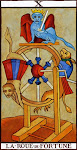
When the militia was dismissed, Cybele moved the children back to the camp; too many vagabonds frequented the tavern for her taste. Jack and Alphonse invested in a second horse for the wagon, Shadow, a powerful draft animal from a Nevis plantation, stronger and younger than True, and nearly as placid. He would be invaluable when it was time for the traveling players to move on in March, when the Bath Hotel shut down for the season. Secretly, Tory hoped that she and Jack would move on to the sea when they departed Nevis. Jack had promised her, and the others—well, Alphonse and Cybele and the Bruces were accustomed to making their own way. But for today Tory was content to idle in the shade of the wagon while Cybele spread out her cards: La Roue, the Wheel of Fortune; L'Amoureux, the Lovers. The quiet was broken now and then by the light tapping of Jack’s hammer as he inspected the wagon for wear.

"Men always tinkering," Cybele observed.

"Aye, you’d think a few whacks of a hammer would cause more damage than it fixed," Tory agreed.

"At least I’m not sitting idle," Jack responded, from the far end of the wagon. "The little green pixies of Devon would pinch you black and blue for your laziness."

"Green pixies," Cybele scoffed. "It sound like obeah. What do you know of such things?"

"We traveled all over Britain to the fairs when I was a lad, and I heard all the stories." Jack’s voice wafted to them from under the carriage. "Tom Thumb and Tom Tit Tot. My father was a Cornishman, so I heard a lot about the pixies and the knockers who mine the tin."

"Jack was a foundling," Tory explained to Cybele, hoping Jack was in a humor to tell them more. He so rarely spoke of his boyhood, and she hungered for any scrap to help complete the picture of his life. "He was raised by tumblers."

"You never know your blood family?" asked Cybele.

Jack came round the front of the wagon to join them, shook back his hair and offered up a shrug. "All I know is I was found in a box behind a row of tents on the second day of the May Fair in some West Midlands village. I might have been only hours old, or possibly a day or two, but no more. Starving, they told me, and squalling like all bloody hell, wrapped up in a cloth, and scarcely cleaned up. Someone must have been in an awful hurry to get rid of me." He smiled a little. After all, it was not as if he could remember being alone and starving and cold and afraid, it was just a story he’d been told.

"You born under the the bull star," Cybele observed. "Too stubborn to die. Fortune make some bigger plan for you."

"Not that I've ever noticed," Jack laughed.

"The pattern in the stars," Cybele murmured over her cards. "Every thing connected. Past and future. Man and boy. Male and female. Love and hate. Pixies and obeah," she winked at Jack. "All part of the pattern the Great Mother weave together from the day you born."

"And there’s nothing you can do about it?" Jack wondered. "Trapped in the spokes of Fortune’s wheel?"

"You can try to understand the pattern. Everything you do, every choice you make become a part of the weave. Only the Great Mother know the whole design. You can only listen to your heart and do what you must."

Jack moved off again to his work, but Tory could not resist when Cybele nodded for her to choose a card. It was L’Etoile, the Star, a woman pouring water into a river under a canopy of stars.

"This card speak of time, which flows like a river and feeds all of life. The stars be dreams waiting to be born, leading you forward. The river of time carry you always into the future. You cannot stop it. You cannot outrun it. You can only ride its currents."

"Or drown," Tory suggested.

"But we all drown in it, one day, every one of us. What matters is the journey."

When Jack came back to the wagon to clean himself up, Tory followed him in.

"Solved the riddle of the stars, have you?" he teased.

"You don’t believe in it?"

He cast her a wry half-smile as he crossed to the stool in the corner with a clean shirt. "Our remedies oft in ourselves do lie which we ascribe to heaven. All this talk of destiny and stars...it’s like blaming mala suerte. If things don’t go right in the event, you can always say, Ah! It’s not my fault. It was destiny, fortune, mala suerte. It was never meant to be."

"So you think there is no destiny," said Tory.

"Oh, aye. Destiny is what happens when you don’t lift a finger to help yourself. Life happens when you do." He turned again to the shirt in his lap, then paused. "Sometimes, onstage in the middle of a play, you might get lost in the text. It happens now and then, however well you think you know the piece. You know where you’ve got to go, but the pathway of words has entirely evaporated. The performance can’t wait, so you must make up the play as you go along, whatever it takes to propel you forward." He shook out his shirt. "There are no promptbooks to life to tell you what to expect, and when. You must make your own play. Invent your own destiny."

Tory was looking at Jack’s bare, scarred back. How often had he stubbornly refused to play the role Fortune had set him? From the very first hours of his existence, a newborn in a box at the May Fair, screaming for his life. She came up behind him and slid her arms around him.

"Si, hombre. The way I made my destiny when I bullied you into loving me."

Jack drew her arms more closely around himself. "Aye, and now you're stuck with me, and none but yourself to blame."


The private room at the back of the Medusa Tavern could be entered from the shadows after nightfall in Basseterre. On this night, at an hour past bell-ring, a broad, rustic table stood in a corner of the spartan room laden with all sorts of small goods. A man hovered in the shadows just beyond the circle of lamp light that bathed the merchandise before him. Even off-duty, without his cap of office to distinguish him, there was something charged and intimidating in the carriage of Chief Constable Stephen Raleigh.

Before him were spread the contents of one small chest and two hempen sacks delivered here tonight by an acquaintance of an associate. Raleigh knew many such gentlemen of venture. They brought him merchandise they had acquired off-island and were willing to pay handsomely for the privilege of selling it unaccosted in the Basseterre market. A fellow had a right to profit by his office, after all. Members of the island Council and Assembly sold their influence every day. Many of the first class of white gentlemen in Basseterre were professional attorneys who derived income from the several estates they managed on behalf of absentee planters, and sold credit to the planters most seriously in arrears. There were staggering financial rewards available to anyone fortunate enough to rise to a lucrative post like Casual Receiver or Collector of Impost on Liquor, if only one had the wit to pursue them. It was all business.

But there were small pickings tonight. Raleigh, sifted through the goods before him: handkerchiefs of lace or lawn, an enamel snuff box, two fancy carved pipes, a pair of pewter candlesticks, a damask tablecloth, a handsome silver bowl. Items a foolishly indulgent master might bestow upon his slaves as gifts, but more likely to be pilfered from him, in that quaint way the darkies had of rationalizing their thefts. How often had he heard some thieving slave claim that one possession could not steal another possession from his master, as if there were no moral issue involved. What a bestial race they were.

There was a larger pile before him of handsome silk gowns, a setting of fine china plate, combs and mirrors with pearl or ivory handles and several pieces of cheap jewelery, mostly gilt and glass but pretty enough in their way. The sort of things mulatta whores were often forced to sell when their white lovers turned them out. Normally, Raleigh would not bother with items of such dubious provenance; larger cargoes of liquor and tobacco brought the biggest payoffs. But he could no longer afford to turn down any possible profit, however small. He was still cash-poor, having paid far more than he could afford for that slave at auction last month. But he’d had no choice after that debacle in the Neck.

It rankled Raleigh even now to think of it, and his bruised back throbbed again with rage and humiliation. Himself, a chief constable of the law assaulted like a common beggar, and by a colored female, a damned harpy, no better than a slave. He had never even seen her coming, only looked up once over his shoulder before he got the crack on his head to see her wild eyes and her hideous, twisted face as she assaulted him with his own club; then the further shame of coming to himself again in the arms of Dr. Spence’s surly darky. It had taken all the cash Raleigh had to buy the fellow’s silence. Then a week on half-pay while he recuperated in private, claiming a spell of fever like a weakling child so he wouldn’t have to account for his wounds. Almost lost his promotion over it, but that he returned to his office with such renewed vigilance.

After that it was important to purchase his first slave property right away, whether or not he could afford it, to regain his standing in the community before any idle rumors of his declining powers or fortune could take root. Then he'd been unable to recoup his investment working the brute out because of the damned slave holidays. A miserable episode altogether that now left him in a position of having to treat with any common riff-raff with the means to purchase a favor. And in the meantime, those damned gipsy beggars had vanished into the air before they could be made to pay for their crime. But pay they would, one day, if he waited long enough. Stephen Raleigh never forgot an injury.

But what was this? Nestled into the folds of a silken veil with a necklace of fake pearls and a red glass hatpin, he noticed a spark of gold. It was a ring of remarkable quality and when he picked it up and held it under the light, he was dazzled by the workmanship. There was an elaborate family crest engraved into the top and when he turned the ring around and examined the inside of the band, he saw that it was inscribed with tiny, delicate words, a name or a motto, in some foreign tongue he could not read. More than a gentleman’s ring, then. A ring belonging to an aristocrat. Possibly even royalty.

Surely no planter nor any of his people would own a bauble like this. A wealthy merchant might acquire such a thing, or possibly a sea captain after an especially profitable venture, or a night of gaming in some foreign port. But how would this fellow come by it, this associate of Captain Trent’s who dealt in such small trade? Had the fellow been thieving above his station?

"Take a look at this, Captain," said Raleigh to the ruddy old seadog sitting in a chair on the other side of the table nursing a pint of porter.

Trent did not get up, but stretched his neck a little to gaze at the ring in the chief constable’s hand.

"Fine looking piece, that," he nodded, settling back again. "Ought to fetch a handsome profit in the market. You ought to increase your percentage, constable."

"It doesn’t belong to you, then?"

"Too fine for the likes o’ me," Captain Trent chuckled. "I prefer simple creature comforts to flash, I do. It’s the gaudy ship gets boarded, I always say."

"What do you know about the fellow who brought this lot in?"

"Good lad, works out of Nevis. We’ve done business before."

"Is he still about?"

"Aye, having a pint in the tap room. Shall I fetch him in?"

A moment later, Captain Trent ushered in a small, plainly dressed mulatto of middle years, the sort of fellow one would never even notice in the street. Raleigh kept to the shadows behind the table and held up the ring.

"This is a rather unusual piece. May I ask where you got it?"

"Oh, sir, me no can reveal the identity of me contacts. It be too bad for business."

"That may be, ah, Mr. Tinker, is it? But it is very bad for my business to traffic with thieves."

"Me no tief it, sir. Me pay a fair price to a little pickney boy in Charlestown, who be glad to get it. Him say him find it outside the Bath Hotel."

Raleigh paused to reconsider. Many rich, well-traveled people stopped at the Bath Hotel for the season, the ring might very well have come from there. How careless the wealthy must be with their possessions to allow some little darky to make off with something so valuable. But how fortunate for him. For an instant he had to repress a smile.

"Belongs to the hotel, does he?" Raleigh nodded. "What a fortunate arrangement for you, Mr. Tinker."

"No, sir, he be only a ragged boy who play antics for his living. Works the marketplace with a colored juggling wench and a black dwarf."

The lamplight seemed to intensify until all that Stephen Raleigh could see before him was white heat. A colored juggling wench and a black dwarf; there could not be another such pair in all the Indies. And as near as Nevis. No mention of that tall, patchwork clown, but that didn’t matter; he didn’t matter. The wench lived.


Alone in his lodgings less than an hour later, Stephen Raleigh had almost completed his plan. He sat in the silent dark so that nothing could distract him as he harried the situation from all angles in his mind. If that insolent Harlequin still lived, there was nothing at all to be done about him. It required far more interest than Raleigh could muster at the moment to get a white man hanged. But that damned colored whore he set such store by, Raleigh would be revenged upon her.

He could not prosecute her legally, of course, not without making himself the object of mockery and ridicule for the rest of his life. Besides, he could not defend himself in a court of law without sooner or later stumbling over the sticky issue of why she had assaulted him in the first place. Not that it mattered when a darky attacked a white person, but if that Harlequin was still about, he would be sure to press the issue. It was uncanny how these white fellows would stick up for their mongrel whores sometimes, even to the disgrace of their own race.

No, there were other, more sure and subtle ways to have his revenge. To break down her insolent pride. If she were alone in the world now, she would be all the more vulnerable to him; he would make her devastation complete. And if the mountebank lived, Raleigh knew that girl was his weakness. Destroy her and he would destroy them both.


(Top: L'Etoile (The Star), from the 18th Century Tarot of Marseilles, as seen on www.wischik.com/lu/tarot/index.html)